Magnitude 4.8 earthquake hits Victoria with tremors felt across Melbourne
2 時間前
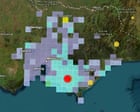
A magnitude 4.8 earthquake struck Victoria in the early hours of Saturday morning, shaking Melbourne and waking people across the whole region.
Geoscience Australia said it detected an earthquake with a preliminary magnitude of 4.8 at 2.01am near Leongatha, 130km south-east of Melbourne, with the tremors felt across the city’s eastern suburbs.
Geoscience Australia said it had received thousands of reports from people who said they had felt the earthquake.
Posting on Facebook , Brian Morley in Narre Warren said “felt it and woke me up”, while Theresa Stevens said: “Shook our house in Garfield.”
Other posts indicated the quake had been felt in Preston, Heidelberg Heights, Venus Bay and many other parts of Melbourne.
The quake was estimated to have struck at about 10km below the Earth’s surface.
Victoria’s State Emergency Service said the earthquake was a “timely reminder” to remember the drill to follow during an earthquake and that was drop to the ground, take cover under a sturdy piece of furniture and protect your head and neck, and hold on until the shaking stops.
The Bureau of Meteorology said there was no tsunami threat from the quake.
The quake occurred in a region of South Gippsland considered to be amongst the most active seismic zones in Australia.
Victoria’s two most recent quakes with magnitudes of 5 or above, however, were recorded elsewhere: a 5.9 magnitude in 2021 near Mansfield, in the state’s north-east, and a 5.0 on the Great Ocean Road in 2023.
The quake on Saturday morning was the largest recorded in the state since that shock in 2023.
An aftershock of 3.1 magnitude was recorded 55 minutes after the 4.8 magnitude earthquake early Saturday, with a magnitude 3.3 earthquake also recorded on Thursday morning at Yarram, about 80km east of Leongatha.
Mark Quigley, associate professor of earthquake science at the University of Melbourne, said aftershocks could be felt for weeks in the region.
“South Gippsland is one of our more seismically active parts of the country,” Quigley told the ABC.
“We know it’s an area where seismicity is common, [and] we know we would expect aftershocks from an earthquake of that magnitude.”
He said the earthquake was the result of a two by three kilometre area of rock about 10km below the surface slipping five to 10 cm rapidly, releasing seismic energy.
Quigley said that earthquakes were not being recorded more often, despite a seeming increase in frequency in recent years.
While the earthquake was “not an opportunity for people to panic or anything”, Quigley said it could be useful for people who lived in the region to consider whether they had items in their houses that could be damaged or create a safety risk in the event of a larger quake.
“We know from the geological record we’ve had much larger in Gippsland in the past, larger than six and possibly as large as magnitude seven which I can assure you would cause widespread damage should they occur.”
The last earthquake to cause property damage in Victoria was the 2021 quake , which resulted in tremors about 700km from the epicentre.
本文の著作権はThe Guardianにあります。